
Triangulating The Offense: Connecting Duke's Big 3 Playmakers
Breaking down a new play series that’s gained traction over the past month for Duke, and how it works with Cam Boozer, Patrick Ngongba and Maliq Brown

Entering the 2025–26 season, it was clear Duke would need to get a little funky offensively. Without a high-usage breakdown guard or a big wing creator — like Cooper Flagg or Kon Knueppel — the Blue Devils’ offense would have to run through their talented frontcourt trio: Cameron Boozer, Patrick Ngongba and Maliq Brown.
Across high-major basketball, only nine players are currenetly shooting better than 65 percent from the field while also posting assist rates of at least 15 percent and defensive rebound rates of 15 percent. That short list includes Texas standout Dailyn Swain, UConn’s Tarris Reed and two-thirds of Michigan’s star-studded frontcourt: forward Yaxel Lendeborg and center Aday Mara. But only one team features three players simultaneously meeting those benchmarks: Duke, with Boozer, Ngongba and Brown.
The season is long, the margins are thin and the numbers will likely shift. However, a review of the Bart Torvik database (dating back to the 2007-08 season) shows that no team has ever finished with more than one player hitting those marks. Likewise, a dive into the Sports Reference archives reveals that no ACC player — going back to the 2002–03 season — has ended a season with those numbers. For the time being, this is uncharted territory and it highlights the unique composition of Duke’s offense.
Through the first 22 games of the season, Duke’s Top 5 offense has produced 10 different two-man assist combinations with 10 or more assists. At least one of Boozer, Ngongba or Brown appears in every one of those assist-to-scorer pairings. For example, Boozer has assisted on 23 Isaiah Evans field goals this season — the most of any two-man group on the roster.
Ngongba has assisted Boozer 17 times, the third-highest total among all combinations. Meanwhile, Boozer has assisted Ngongba 16 times, good for fourth. Brown has dished 15 assists to Boozer, ranking fifth, while Boozer’s 14 assists to Brown rank sixth.
Caleb Foster, Cayden Boozer and Evans have stepped up at times to provide crucial on-ball initiation for the Blue Devils. Still, Duke’s Top 10 offense has largely revolved around five-out initiation, inverted pick-and-rolls — particularly involving Boozer and Evans — and the post play of its three frontcourt hubs.
Lineup Stats
Boozer is the primary engine of Duke’s offense, thus he proves to be a vital on-off piece. Lineups that feature Boozer and Ngongba or Boozer and Brown have absolutely demolished opponents this season, according to CBB Analytics:
Boozer and Ngongba, no Brown: +243 in 387 minutes (+64 in 190 minutes vs. Quad 1 teams), 125.8 points per 100 possessions on offense (97th percentile), 88.8 points allowed per 100 possessions on defense (100th percentile), net rating of +37.1 points per 100 possessions (100th percentile)
Boozer and Brown, no Ngongba: +137 in 297 minutes (+28 in 143 minutes vs. Quad 1 teams), 128.9 points per 100 possessions on offense (99th percentile), 101.4 points allowed by 100 possessions on offense (89th percentile), net rating of +27.3 points per 100 possessions (98th percentile)
Ngongba and Brown, no Boozer: +13 in 70 minutes (+12 in 34 minutes vs. Quad 1 teams), 100.7 points per 100 possessions on offense (12th percentile), 89.6 points allowed per 100 possessions on defense (100th percentile), net rating of +11.1 points per 100 possessions (80th percentile)
Boozer, Ngongba and Brown together: +0 in 17 minutes, 110.6 points scored per 100 possessions on offense (51st percentile), 110.6 points allowed by 100 possessions on defense (49th percentile)
Boozer on, no Ngongba or Brown: +3 in 14 minutes
Unsurprisingly, the offense takes a noticeable dip when Boozer sits; the spacing and on-ball playmaking just isn’t the same with lineups powered by Ngongba and Brown, although those units have defended well and are +12 in Quad 1 games. That’s enough to hold the fort down.
The bottom line: this offense is powered by a unique playmaking apparatus, one that inverts the action and subverts the conventional guard-driven model. To that end, it behooves Jon Scheyer to find as many ways as possible to synchronize the various two-man combinations of Ngongba, Boozer and Brown when they share the floor — particularly in concert with Isaiah Evans and his off-ball gravity.
Inside Angle: Triangle Series
After Duke bookended its holiday break with two lackluster performances — blowing a 17-point lead to Texas Tech in Manhattan, then grinding out a listless six-point win over a Georgia Tech team that barely cracks the Top 200 nationally in adjusted offensive efficiency — the Blue Devils rebounded with a road win at Florida State.
Down in Tallahassee, Duke unveiled a collection of offensive sets built off the same underlying action, which I’ve dubbed its “Triangle” series.
I’m not sure what terminology the Blue Devils use internally, but the name fits: after the initial ball and player movement, Duke ends up with three players stationed in the middle of the floor in a triangular alignment: the 5 (Ngongba or Brown) at the top of the key, the 4 (Boozer) on one low block and a shooter/creator (Evans or Foster) on the opposite block.
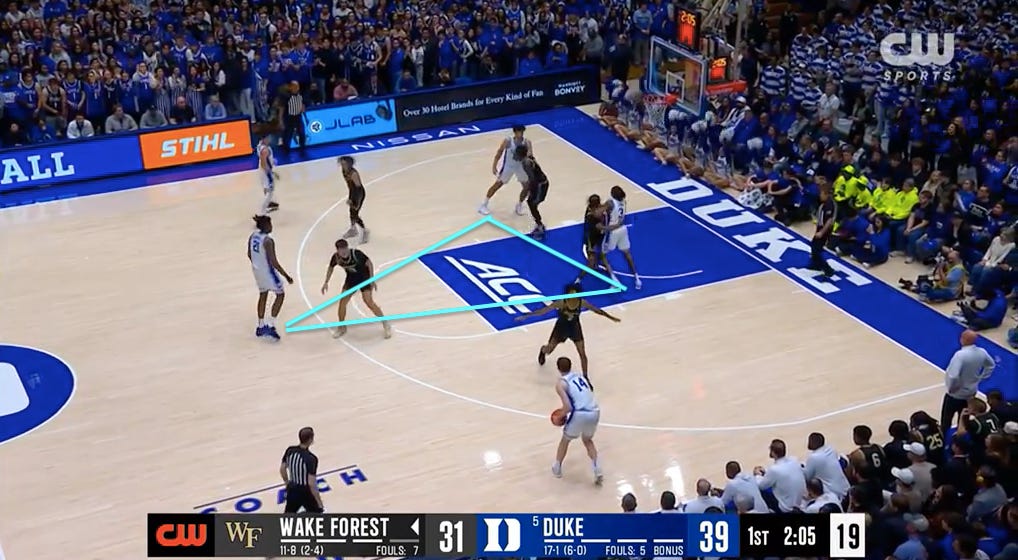
Regardless of how it’s labeled, the series has been a big hit for Duke. Beginning with the Florida State game, the Blue Devils have outscored their ACC opponents, including two double-digit wins over Top 20 Louisville, by a combined 151 points, while scoring 124.1 points per 100 possessions, both elite figures.
I also use the “Triangle” label because, in both shape and featured actions, it resembles the Inside Triangle/Motion (“Middle Third”) offensive series Tony Bennett ran at Virginia. That package served as Bennett’s secondary base offense, complementing his famed Blocker Mover (“Sides”) system. For reference, during the 2022–23 season, Virginia frequently ran its Triangle/Motion offense against Duke.
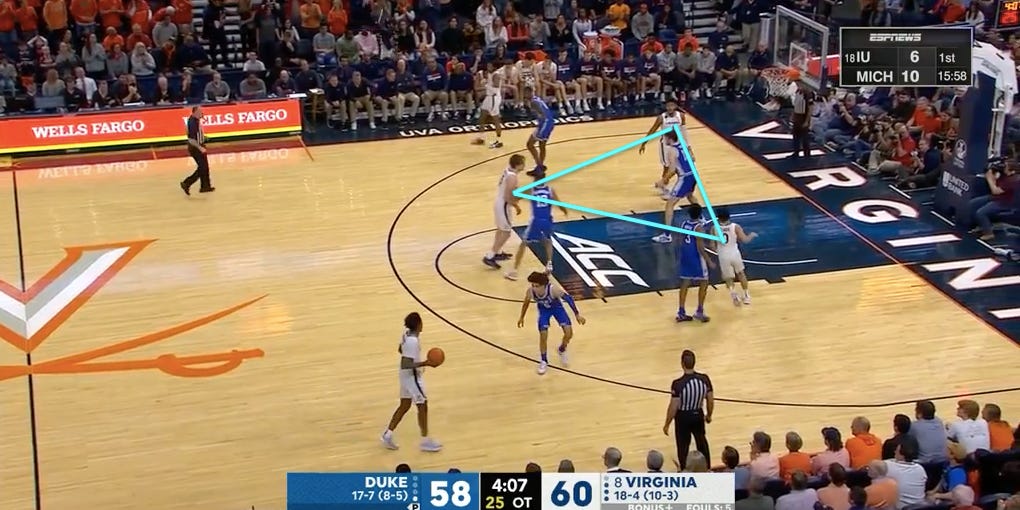
The key difference, however, is this: Virginia ran the series as a continuity offense: two players spaced on opposite sides of the floor, with three others continuously interacting in the middle third through screening, passing and cutting.
Duke, by contrast, has built defined reads into these looks. If those scripted progressions don’t materialize, the Blue Devils flow seamlessly into their 5-out offense and play from there, rather than maintaining continuous middle-third action.
Now, let’s dive deeper into the series and examine the different ways Duke has generated offense with its three-headed frontcourt hydra — plus Evans — starting with how the set initially unfolds and how it functions when opponents send a double team to the post.
Attacking Double Teams: Post-to-Post
The action begins with staggered down screens set by the 4 and 5 for a guard lifting out of the corner. On this possession against Wake Forest, Cam Boozer and Ngongba provide the down screens for Evans.
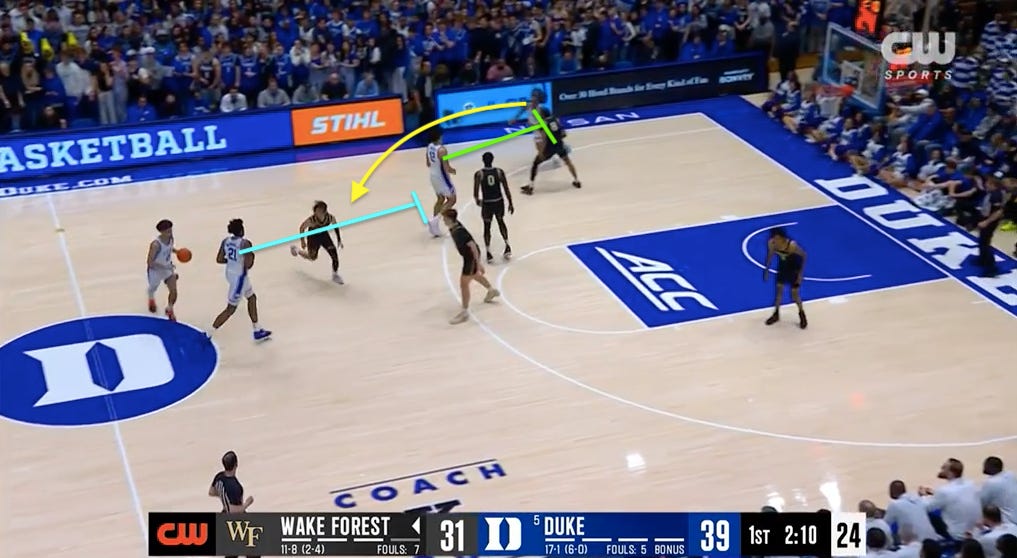
Evans isn’t using the down screens to hunt a jumper or a quick curl. The movement is simply a trigger to start the action and generate offensive rhythm. He cuts off the screens and clears to the right side of the floor. As Cam Boozer dives to the left block, Ngongba lifts to the top of the key and receives an entry pass from Cayden Boozer.
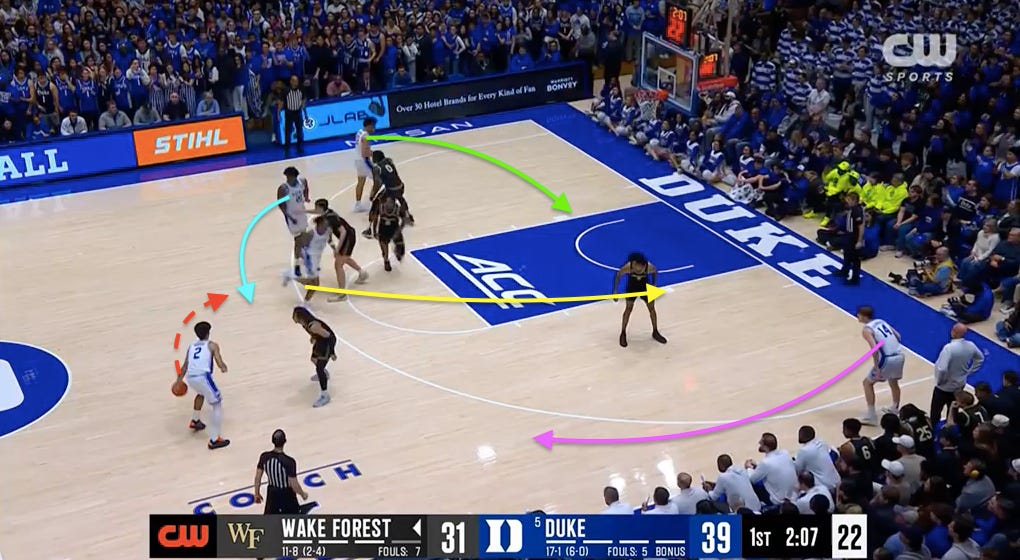
Ngongba fakes a handoff back to Cayden Boozer as Nik Khamenia lifts from the opposite wing. Ngongba then swings the ball to Khamenia, while Evans slides into the paint to set a cross screen for Boozer, freeing him to the strong-side post.
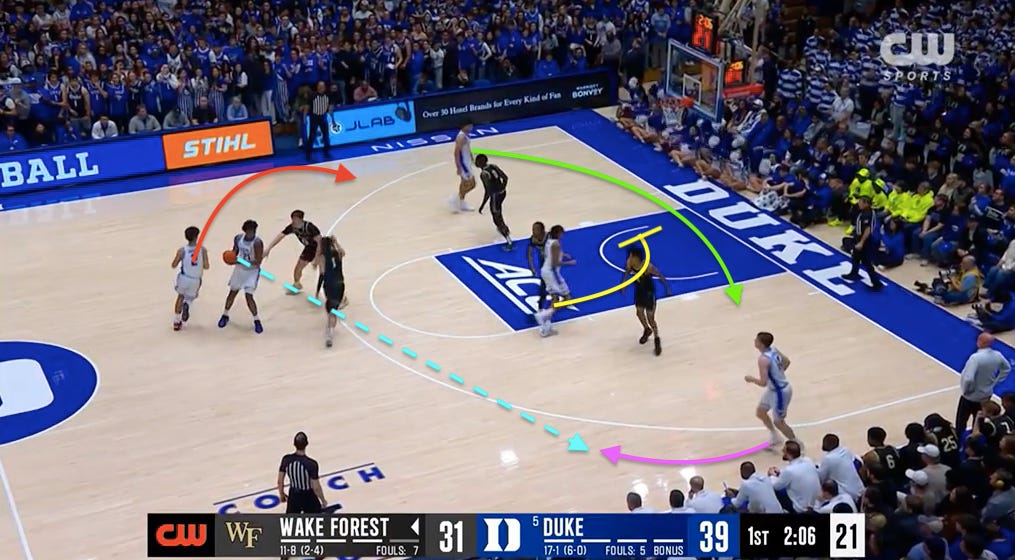
This is old school basketball: a cross screen leading into a post-up. It’s a simple action, but the screen from Evans lets Boozer establish strong post position as he cuts toward the ball. After setting the cross screen, Evans flows into screen-the-screener (STS) action, cutting up the middle of the lane off a pindown from the 5, Ngongba.
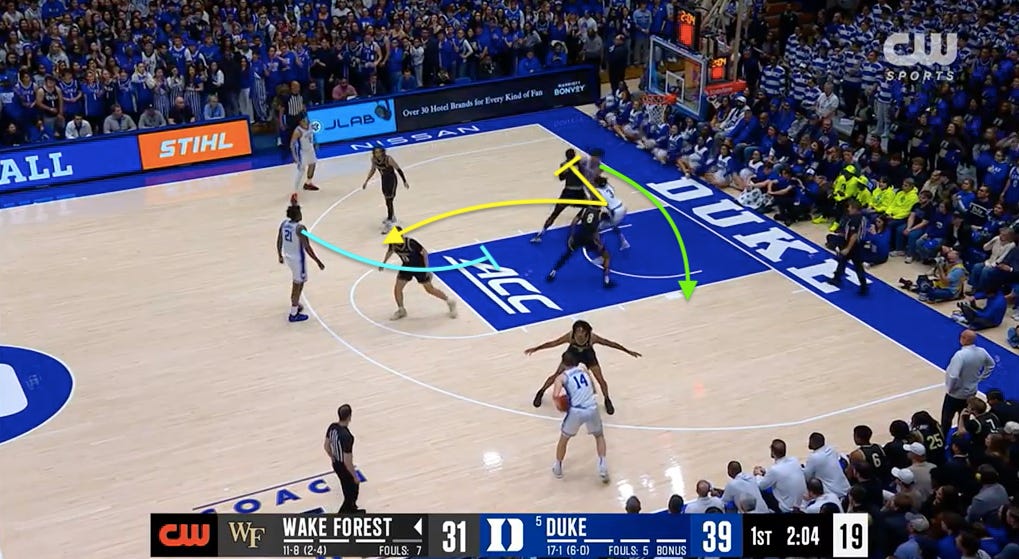
This screen-the-screener action clears out the paint for Boozer while giving the wing another passing option.
Khamenia chooses a post-entry pass to Boozer, which is never a bad decision. Wake Forest immediately brings a post-post double team on the catch, but point guard Nate Calmese is slow to rotate from the weak-side wing, leaving Ngongba open. Boozer makes a quick read and delivers the ball to Ngongba for the big-to-big cut finish.
Here’s the same action from earlier in the first half against Wake Forest — this time with Foster at the 1, Brown at the 5 and Dame Sarr replacing Khamenia. Once again, the Demon Deacons send a double team at Boozer. Wake Forest center Cooper Schwieger (13) leaves Brown to trap Boozer, but backup point guard Sebastian Akins (10) never rotates down from Foster.
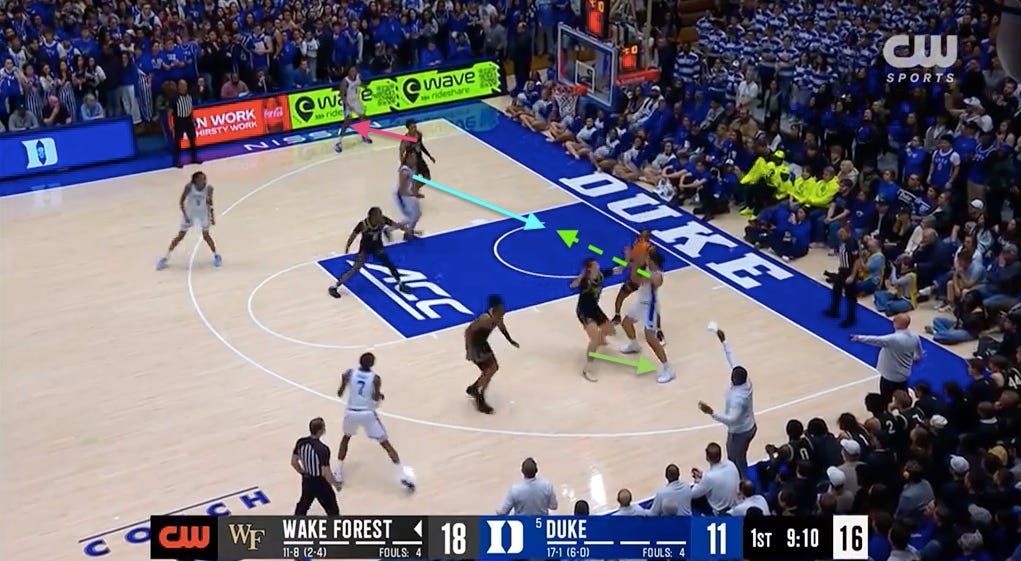
This missed rotation by Akins proves costly, leaving Brown (75.8 2P%) wide open for an uncontested dunk off Boozer’s pass. Brown has 24 dunks on the season now, which ranks third on the roster behind — of course — Boozer (29) and Ngongba (30).
You can see from his reaction in the bottom right corner that Wake Forest head coach Steven Forbes wasn’t thrilled with the misstep. This is where Boozer’s passing puts opponents in a tough spot: if you send a second defender to double him in the post, your help-side rotations must be flawless. Slip up, and Boozer will make you pay.
As a result, midway through the game, after Boozer had exploited Wake Forest’s double teams multiple times, Forbes adjusted, opting to defend Boozer’s post-ups 1-on-1. That, of course, carries its own risks. With space and time, Boozer can dominate in isolation, which he does early after the adjustment — powering through Schwieger for a point-blank layup.
Boston College and Earl Grant chose to defend Boozer 1-on-1 in the post. That approach at least limits his passing. When Boozer does pass out of the post, it often leads to interior cuts and perimeter spot-ups, allowing teammates to step into efficient catch-and-finish opportunities. In theory, single coverage keeps the ball in front and forces Boozer to finish through contact.
For that strategy to even have a chance, though, the primary defender must stay attached to Boozer. Instead, Boston College power forward Aidan Shaw (23) tries to shoot the gap and fight over Foster’s cross screen for Boozer, rather than trailing him from behind.
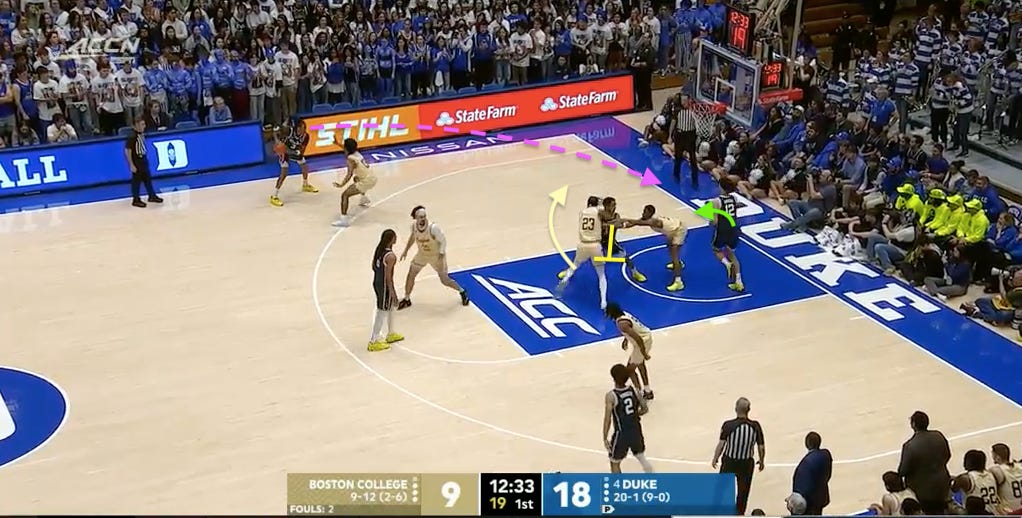
Boozer and Evans are ready for Shaw’s defensive misadventure. Instead of cutting toward the mid-post, Boozer stops in the dunker spot, forcing Shaw to cover extra ground to recover as Evans delivers the pass. The result: another layup for Boozer.
Even when the action is defended well, the trio of Boozer, Ngongba, and Brown have the size, skill and synergy to make it work.
Out west, here’s the same play at Stanford. Evans doesn’t set a perfect cross screen, but Boozer still carves out strong position — prompting another post-to-post double team. Brown, however, seals effectively in the paint on the weak-side guard, opening a window for Boozer to thread a slick pass.
According to CBB Analytics, over 47 percent of Boozer’s assists this season have resulted in rim finishes (76th percentile), giving him a team-leading 2.4 rim assists per 40 minutes (99th percentile). Ngongba isn’t far behind, with 2.3 rim assists per 40 minutes — an impressive 65.9 percent of his total assists (96th percentile). Lineups with Boozer and Ngongba on the floor together are shooting 69.9 percent at the rim (91st percentile).
Attacking Double Teams: Guard-to-Post, One Pass Away
Not every defense doubles the post the same way. Some coaches, like NC State’s Will Wade, prefer to send help from the baseline, while others — when they double — want the extra defender to be the guard one pass away.
This was the approach Pat Kelsey and Louisville used against Boozer last week. As Boozer cuts to the right mid-post off Foster’s screen, Louisville guard Ryan Conwell (3) digs off Sarr in the right slot. This positions a big man between Ngongba and Boozer while keeping weak-side guards Mikel Brown (0) and Adrian Wooley (14) close enough to monitor Foster and Cayden Boozer.
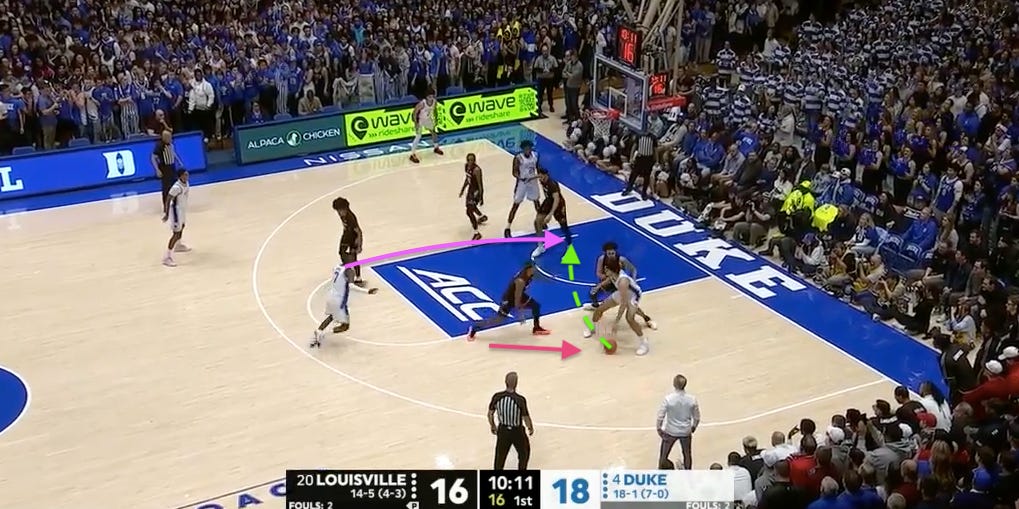
Louisville has the weak-side kick-outs and dunker spot well covered as Conwell comes to double Boozer, but two defenders on the ball inevitably leave someone open. Rather than remaining stationary, Sarr makes a heady move — cutting down the lane, receiving a pass from Cam Boozer and building the advantage with a quick kick-out to Cayden Boozer, who slashes into the paint for the finish.
Think of it this way: sending help from one pass away is risky, as it creates an easy outlet opportunity for Boozer.
During Duke’s win over SMU, the Mustangs also tried to double Cam from up top: a roving guard one pass away.
On this possession, SMU did a solid job covering the initial reads. Jaden Toombs (10) battles Boozer, forcing him to re-post and attack from a face-up position. As Boozer turns away from the help defense, guard Jaron Pierre (5) sneaks down from Sarr to surprise him with a double team dig. Boozer senses Pierre, spins off his left shoulder and delivers the kick-out to Sarr, who keeps the advantage chain alive for Duke with a quick swing to Foster in the weak-side corner.
Foster misses two good catch-and-shoot looks from deep on this possession, but the process is good. Draw two defenders to the ball and play off the advantage.
Hi Lo vs. Fronting The Post
Later in the matchup with Louisville in Durham, the Cards made some adjustments, trying different coverages on Boozer, including fronting the post. As Evans sets the cross screen for Boozer, Louisville big man Vangelis Zougris (53) works hard to fight through the screen, chase Boozer from behind and then swivel around to front him in the post, denying an easy entry pass from Khamenia.
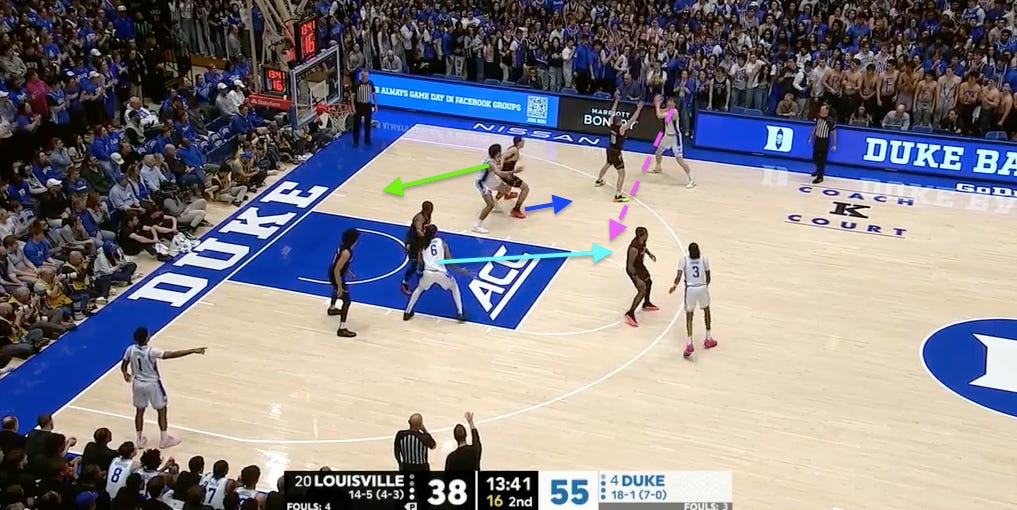
This is where having high-feel, skilled passers like Brown and Ngongba — two big men who truly understand the game — really pays off. It’s automatic for Duke: with Boozer fronted, the opposite post (Brown) flashes to the elbow or nail while Boozer seals in the paint, setting up an over-the-top hi-lo opportunity with Brown.
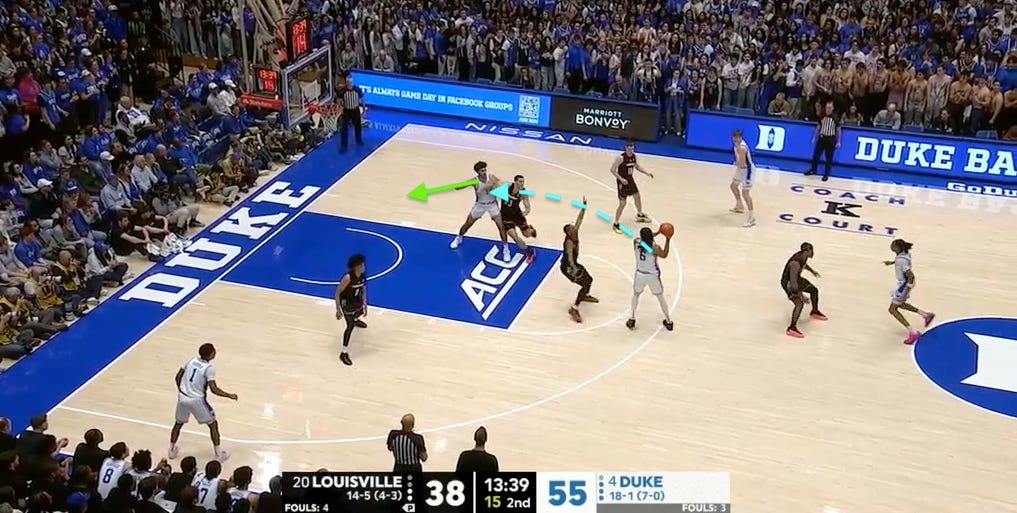
It’s Basketball Geometry 101: if the defense fronts the low post, flash another player to the middle of the floor and look for a hi-lo opportunity. As Khamenia dribbles left, Evans smartly lifts further up the floor, giving Brown more room in the high post.
With the defense elevated and Zougris fronting, Brown delivers a lob entry pass that only Boozer can high-point for a quick finish.
Put a Pin In It: Evans as an Off-Ball Mover
While Boozer serves as the primary option in this series as the low-post hub, the screen-the-screener action can create quality looks for Evans, one of the top movement shooters in the country. Boozer naturally draws defensive attention coming off the screen, and if the defenders fail to communicate properly, Evans can slip free — creating major problems for the defense.
That’s exactly what happens here as Duke opens the second half at Florida State with this Triangle STS setup.
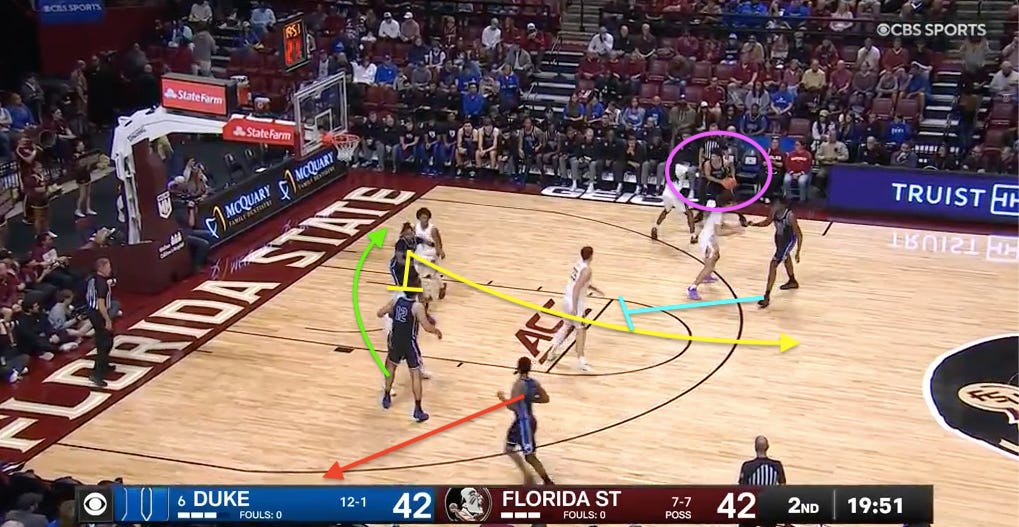
After Evans sets the screen for Boozer, FSU’s defense is left scrambled. Martin Somerville (1) switches off Evans onto Boozer, fronting him in the post. Despite the size disadvantage for Somerville, that’d be mostly fine — except Boozer’s original defender, forward Chauncey Wiggins (7), doesn’t pick up Evans. Instead, Wiggins stays with Boozer, leaving FSU doubling a low-post player who doesn’t even have the ball.
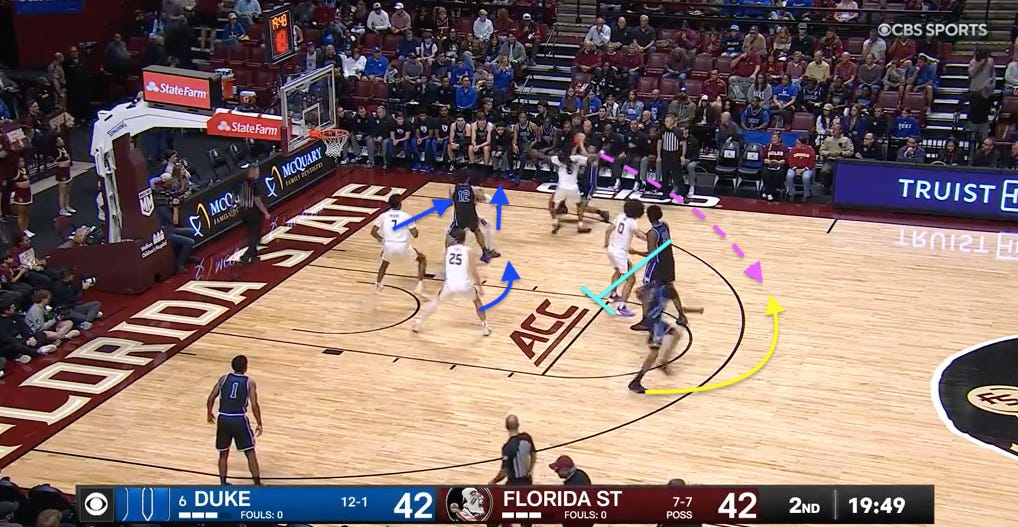
In fact, a third defender, center Alex Steen (25), has both feet in the paint, sagging off Foster, as Evans curls off Ngongba’s down screen. Evans misses the shot, but it’s good process by Duke, creating a clean catch-and-shoot opportunity for the team’s top long-range threat.
Playing Out Of The Play
If Duke looks to Evans on the screen-the-screener action but the space needed for a deep shot is taken away, the Blue Devils can flow seamlessly into their 5-out read-and-react offense, as I mentioned above.
On the first half-court possession at Louisville, Isaac McKneely (1) denies Evans the open look off the down screen. Evans counters with a “Get” action — throwing the ball to Ngongba and chasing after it. Ngongba fakes the handoff back to Evans, who curls around him and cuts to the basket, pulling Sananda Fru (13) deeper into the lane as a help defender. With Fru several steps below the arc, Ngongba faces up and fires from deep.
It’s a miss for the sophomore center, but that snappy two-man game that Evans and Ngongba get to is good stuff.
To clog the lane against Boozer and stay with Evans, some opponents choose to have their centers sag off Brown and Ngongba, effectively keeping an extra defender as a “free safety” in the middle of the lane. This is exactly how Mike Young and Virginia Tech positioned Amani Hansberry (13) against Brown on this play. With Brown a full step above the arc, Hansberry stands on the ACC logo in the middle of the lane.
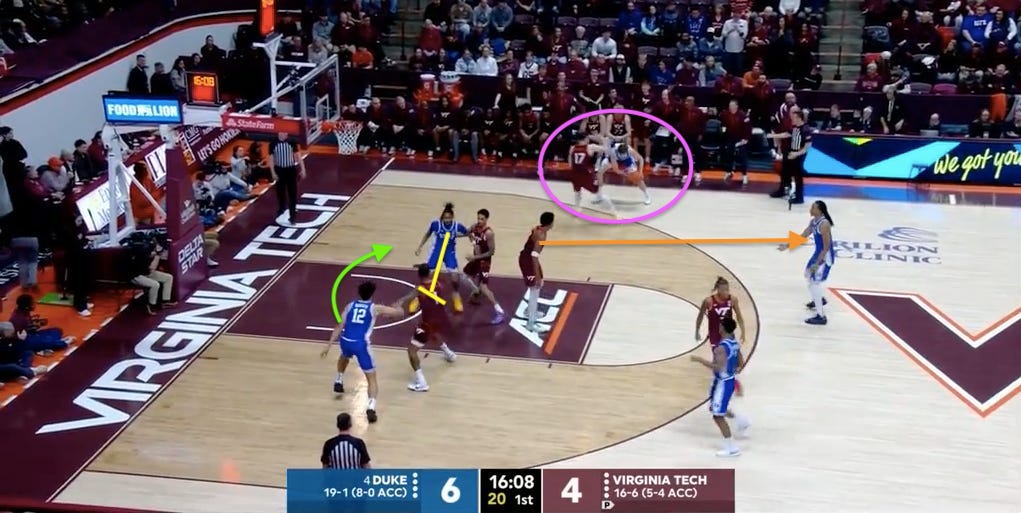
Ngongba (7-of 24 3PA) and Brown (3-of-15 3PA) are capable shooters, but they aren’t exactly stretch-5s. That said, both have been empowered by Duke’s staff to take 3s.
If the opposing center plays off them, they can look to let if fly, which is what happens here: as Khamenia swings the ball to a wide-open Brown, Evans brakes on his cut and reverses the play’s predetermined progressions — effectively setting a screen for Brown.
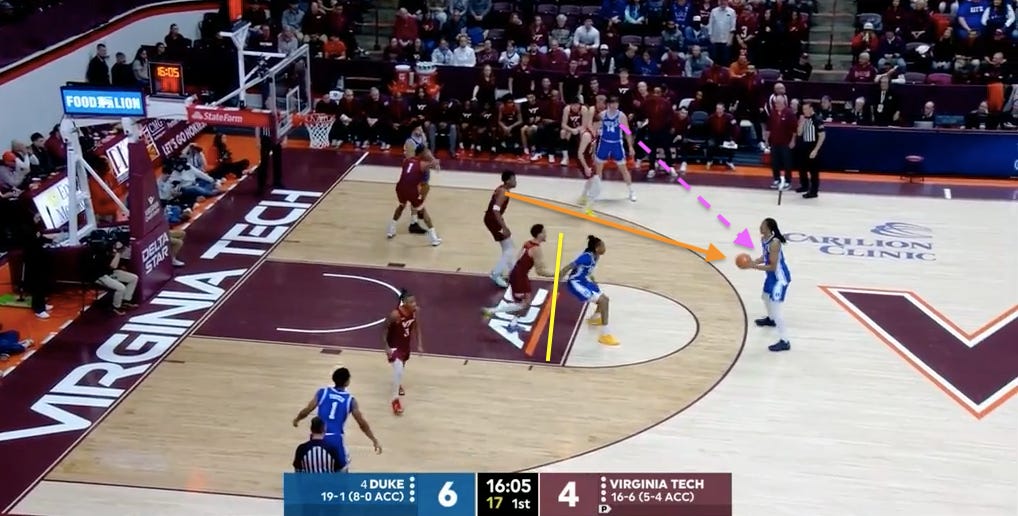
Hansberry is halfway down the lane, and no Virginia Tech defender even makes an effort to close out on Brown, who drills the open triple.
During the second half in Blacksburg, it’s the same set against the same coverage: Tobi Lawal (1) fronts Boozer in the post and Hansberry defends Brown off the body — preventing a lob over the top to Boozer.
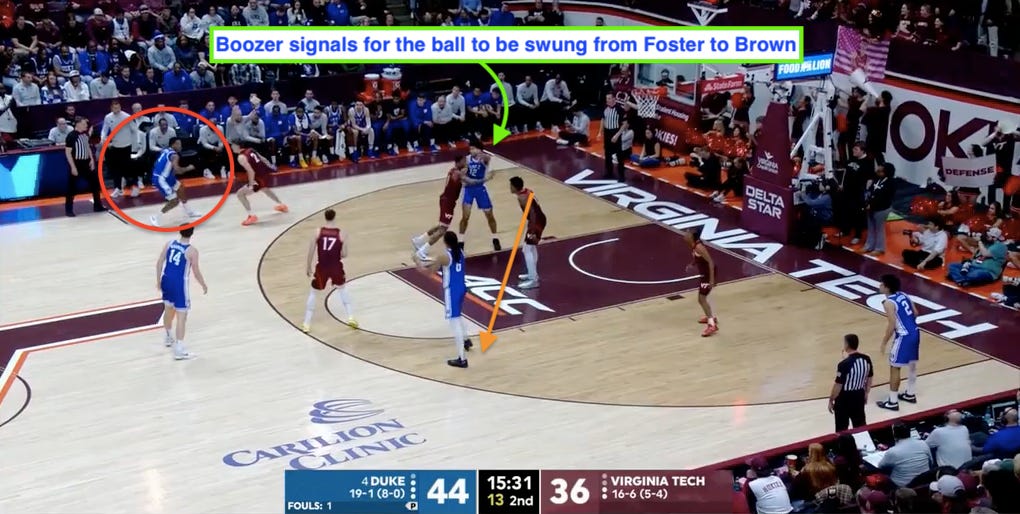
As they did against the Louisville post fronts, the Blue Devils look to feed the high post to open up hi-lo action to Boozer. Hansberry, however, stays in the paint—Virginia Tech refuses to give Boozer a hi-lo feed. Left open, Brown pulls up and misses, but Boozer grabs the offensive rebound. With Hansberry now unassigned due to the junk coverage, Brown cuts into open space, sliding down the lane for a two-handed chin-up finish, courtesy of Boozer.
Reverse Action
Over the last few games, Duke has taken this initial play design and built on it, adding different counters and reads to create confusion. This is what I call the “Triangle Reverse Punch,” designed to generate a post-up for Boozer without using the cross-screen action.
To start, the 4 and 5 — Boozer and Brown, respectively — set the same staggered down screens for Evans coming out of the left corner.
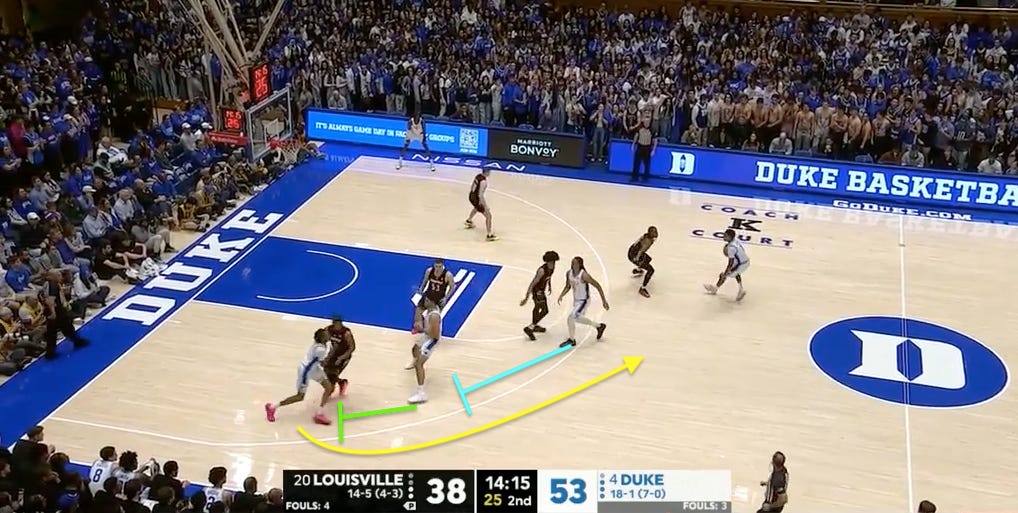
Same setup, but a soon-to-be different story. Brown pops to the middle of the floor as Foster, the 1, passes to him and cuts to the left wing. Meanwhile, Sarr shakes up the right side of the floor. Once again, Duke has its triangle in the middle with Boozer, Evans and Brown.
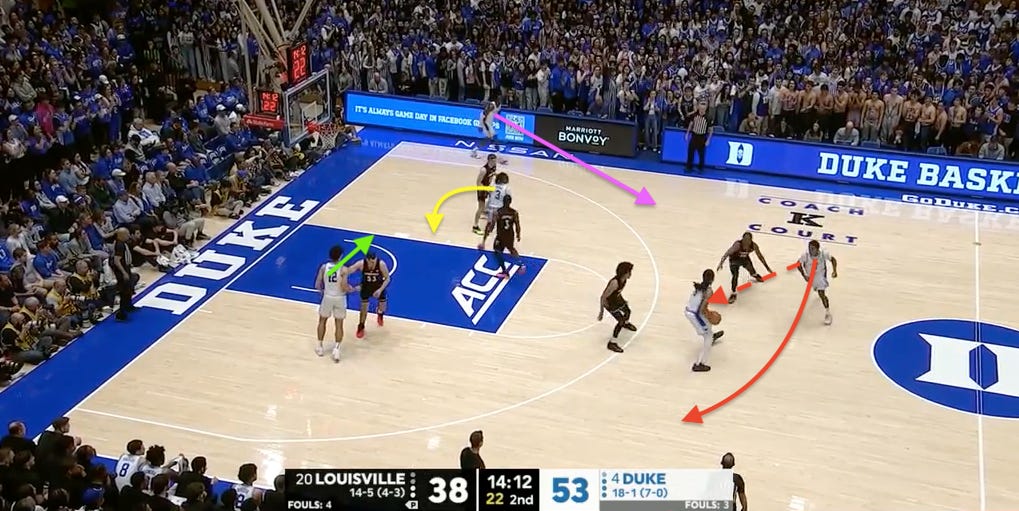
Brown doesn’t swing the ball to Sarr on the right flank, though, He pivots, reverses the ball and passes back to Foster on the left. With the ball now on the left side, Boozer fakes toward the middle, then seals, with Foster in position for the post-entry pass.
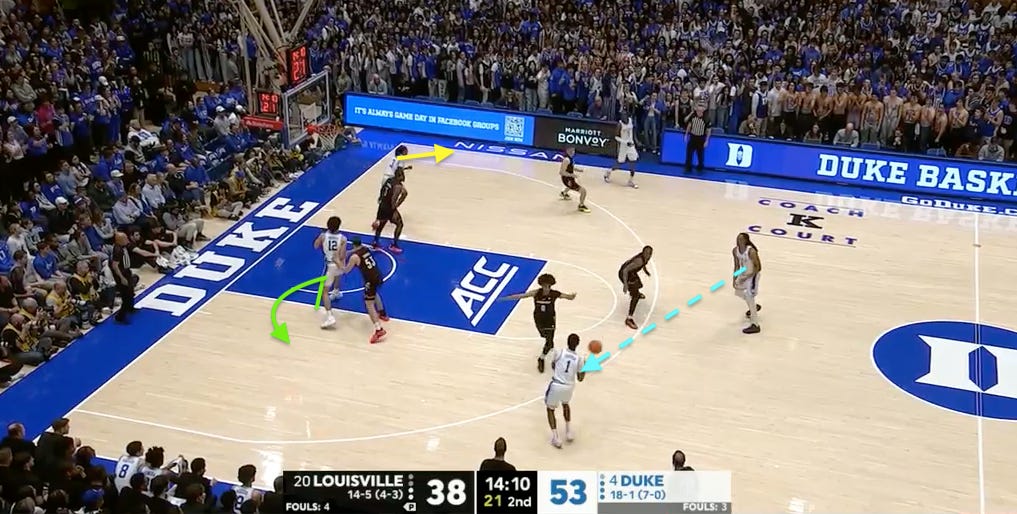
This subtle reverse fake lets Boozer secure strong position sans cross screen and counter Louisville’s defensive front. Zougris gets pinned under Boozer’s quick seal move.
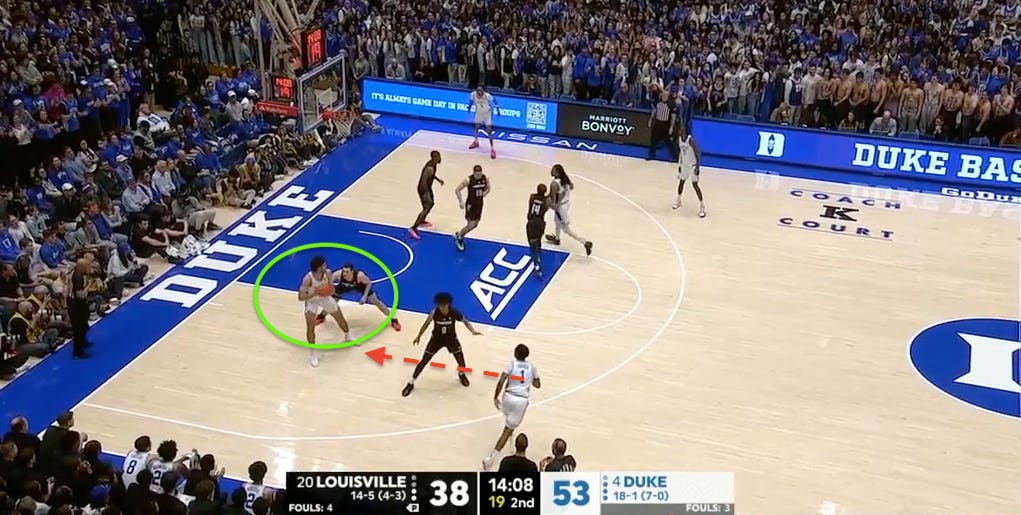
From here, Boozer can do his thing and operate in the post with space, as three shooters space the floor and Brown cuts to the basket, occupying any defenders who might double team the ball.
Next, here’s the same Reverse post-up action for Boozer against Boston College. Boozer’s spin into the paint draws late help, and he finds Brown for another cutting finish at the hoop.
UCLA Cut
Another variation of this series, which Duke ran at Cal, features a post-up for the 5 off a UCLA cut. (A UCLA screen is a back screen that lets a player cut from the strong-side slot to the basket after passing the ball to the wing.)
After the staggered screens, the 5 (Ngongba) lifts to the middle and receives a pass from the 1 (Foster), then fakes a handoff back to the 1 before swinging the ball to the opposite wing.
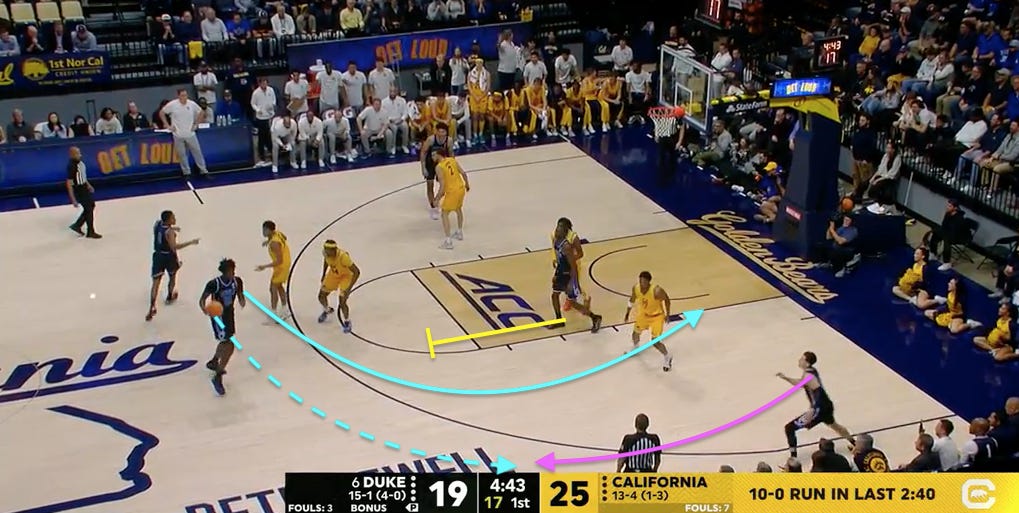
From the strong-side slot, Ngongba passes to Darren Harris on the right wing. Sarr doesn’t set a cross screen for Boozer this time; instead, he lifts and sets a back screen for Ngongba, who UCLA cuts to the right block. Harris feeds the post and then cuts to the weak side, while Duke spaces the floor around Ngongba’s post touch.
Cal stays home and defends Ngongba’s post-up well, but Foster finds a gap and drives into the paint off an extra pass from Harris. (It’s a quiet feature of his game, but Harris, when he plays, routinely hits the right notes in swing-swing situations and makes the extra pass.)
Floppy
Let’s look at one more variation from this series: the Blue Devils using it to initiate what resembles single-double “Floppy” action for Evans. The action begins the same way, with staggered down screens from Ngongba and Boozer for Evans. Ngongba lifts to the middle and receives the entry pass from Foster.
Here’s where things change: Sarr stays in the corner instead of lifting to the opposite wing, and Ngongba immediately flips the ball back to Foster. There’s no fake DHO exchange between the 5 and 1, and Evans clears to the bottom of the lane.
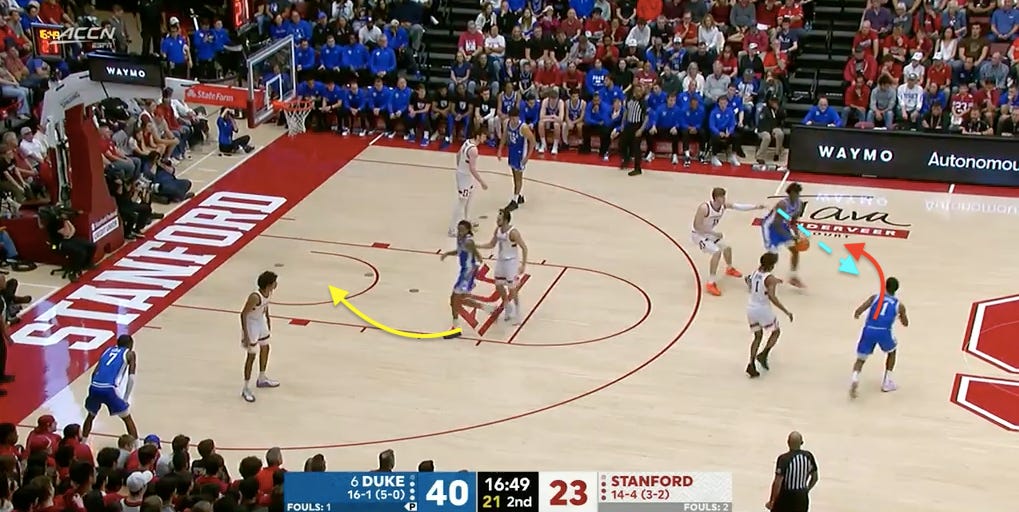
With Evans now positioned under the basket in the restricted area, the Blue Devils have a single-double setup in place. Boozer provides a single down screen to the right side for Evans, while Sarr and Ngongba can set staggered pindowns on the left. Evans chooses Boozer’s side, and Sarr adjusts his path, cutting up the wing off a down screen from Ngongba.
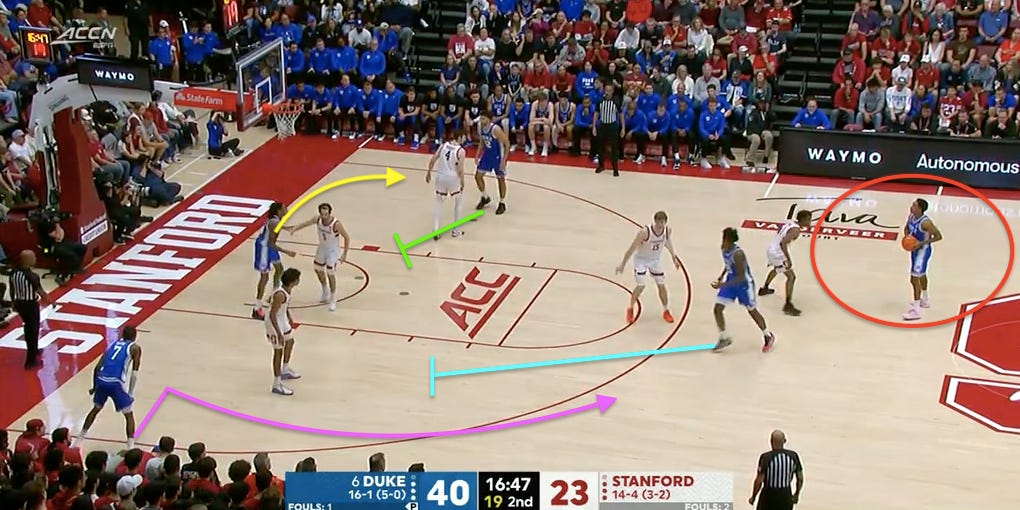
Evans curls around the screen with his defender in rearview pursuit. He misses the layup, despite some contact around the rim as he attacks downhill. Regardless, it’s a quality look for Evans.
Here’s the same Floppy setup against Wake Forest. Evans again chooses Boozer’s side and curls around the down screen—this time on the left side of the floor. It looks like he has a clear lane to the rim, but as he drives, Juke Harris — one of the top NBA prospects in the country — digs off Khamenia and hangs in the gap to strip the ball.
In the matchup against Boston College, Duke ran a similar off-ball setup for Evans — with a slight twist.
On this possession vs. BC, Sarr initiates by curling the staggered screens from Boozer and Brown, while Evans spaces out to the strong-side corner. Foster gets the action started up top.
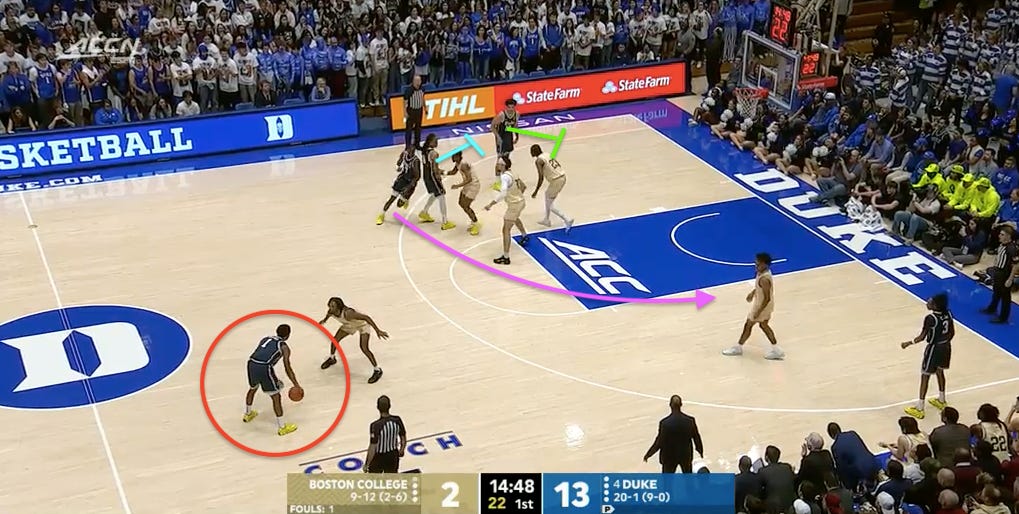
Brown pops to the top of the key and receives a pass from Foster. Without dribbling, he immediately flips it back to Foster and cuts to the right, positioning himself as a potential screener for Evans in the right corner. Evans takes a step toward Brown, then plants and cuts the other way, running off pindowns from Sarr and Boozer.
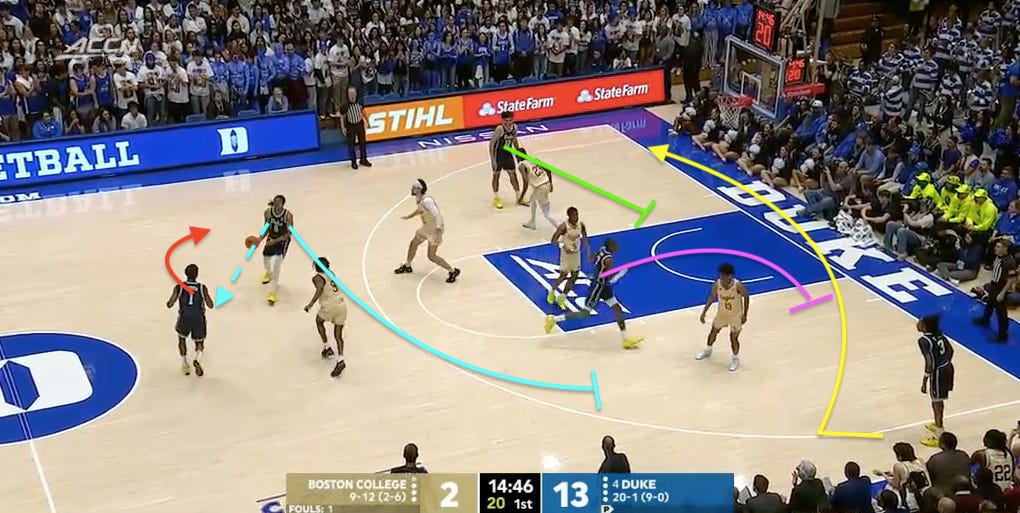
As Evans curls off the double down screens, Sarr lifts off a single pindown from Brown. With his defender, Donald Hand Jr. (13), trailing from behind, Evans’ curl forces Foster’s defender, Chase Forte (9), to jump to the ball and cover the gap. With a second defender on the ball, the screen-and-roll shifts from a 2-on-1 with Evans and Boozer into a 3-on-2, as Evans, Boozer and Foster — relocating from the left slot to the middle — go to work.
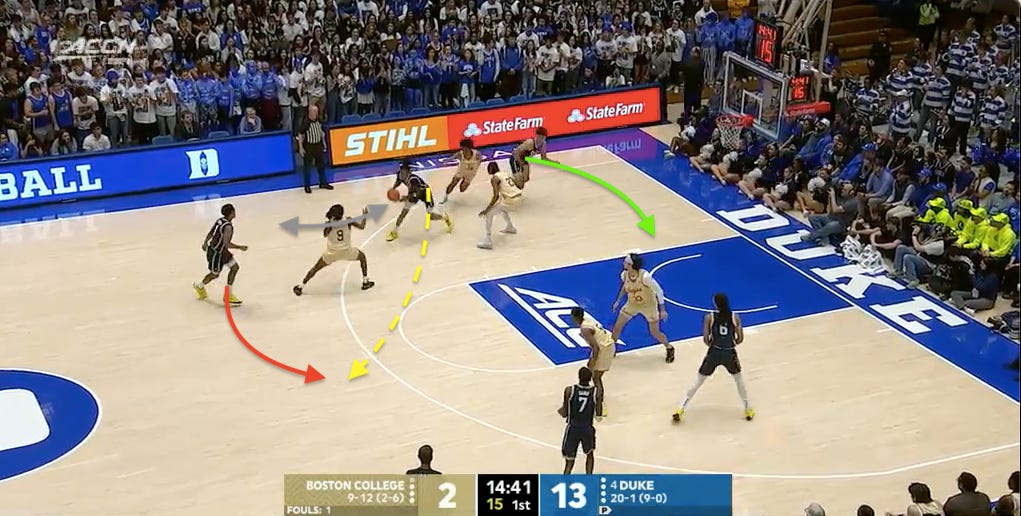
Foster’s cut may look nondescript, but it puts him in space and opens a passing window for Evans. When Forte scrambles to close out, Foster uses a shot fake, attacks downhill on the catch-and-go, gets to the rim and draws a shooting foul.
Finally…It’s Time To Look Ahead
Duke will travel to Chapel Hill this weekend for the first of two regular-season meetings with UNC. It’ll be interesting to see whether Duke runs this action against the Tar Heels, how UNC defends it and what new variations the Blue Devils might explore.
Stay tuned to Split The Action for a full preview of the matchup later this week!