
John Blackwell Scouting Report: Multi-level Shot-making, Off-ball Scoring, Fit in Duke's System
An in-depth look at guard John Blackwell’s offensive game, shooting upside and potential chemistry with Patrick Ngongba as he looks to become a difference-maker at Duke.

Note: This story was originally published last month (April 22) on The Devils Den, the 247Sports site dedicated to Duke coverage. With TDD’s permission, I’m sharing my scouting report on John Blackwell here as well, now that Blackwell has officially withdrawn from the 2026 NBA Draft following his NBA Combine appearance. Huge thanks to TDD for their flexibility!
A busy offseason in Durham has gathered momentum in for Duke basketball with commitments from two marquee transfer portal prospects: PF/C Drew Scharnowski (6-9, 225) from Belmont and Wisconsin guard John Blackwell (6-4, 203).
(This story was originally published prior to the commitment of FC Barcelona PF/C Joaquim Boumtje-Boumtje. If you want to read more about Boumtje-Boumtje, you can check out my scouting report on the star southpaw at The Devils Den.)
During his junior season, Blackwell’s usage rate held steady at 25.6 percent as he developed into one of the top shooters in the Big Ten, posting career highs in offensive box plus-minus, true shooting percentage (59.3 TS%), free throw percentage (85.9 FT%) and total 3-pointers made (96).
Let’s take a look at what he brings to the table, how he fits with Duke’s current roster and where he may excel most within the team’s scheme.
The Archetype
Since taking over as head coach ahead of the 2022–23 season, Jon Scheyer’s teams have consistently featured at least one player who attempts 10 or more 3-pointers per 100 possessions while shooting above 35 percent from beyond the arc.
For his career, Blackwell averaged 9.9 3-point attempts per 100 possessions while shooting 37.3 percent from beyond the arc and posting a 58 percent true shooting rate. As a junior, he increased his volume to 12.5 3-point attempts per 100 possessions, connecting on 38.9 percent from deep while serving as a catalyst for one of the most explosive offenses in the country.
Blackwell has been an efficient and productive player throughout his time at Wisconsin, but in his third season in Madison, he put together one of the better high-volume shooting campaigns in the country. According to Bart Torvik’s database, he was one of just eight Division I players with 200+ 2PA, 200+ 3PA and a true shooting rate above 58 percent. That group includes some of the nation’s top shooters, including potential 2026 first round picks Darius Acuff, Keaton Wagler, Bennett Stirtz, Labaron Philon and Cameron Carr, along with draft prospect — and one of the top players in the portal — former Wake Forest (now Tennessee) swingman Juke Harris.
Catch-and-Shoot: Keep It Moving
The best aspect of Blackwell’s game — the trait that drove his appeal in the portal — is his ability to make shots, especially off the catch. He’s a high-volume, quick-trigger 3-point bomber who can fire off movement and under pressure. With this skill set, Blackwell projects as a crucial off-ball movement shooter and a secondary creator for the Blue Devils.
Players like Blackwell — those who provide significant value even when they’re off the ball — make everything easier for a half-court offense. He spaces the floor, opens driving lanes and punishes defenses by attacking closeouts. At Duke, he’ll play alongside three strong sources of live-ball rim pressure in the backcourt: Cayden Boozer, Caleb Foster and Deron Rippey Jr.
When those guards get downhill — whether in transition or in half-court pick-and-roll actions with Patrick Ngongba (42 dunks last season), Cam Williams or Drew Scharnowski (44 dunks) — Blackwell projects as a Tier 1 spot-up shooting threat, thriving on drive-and-kick 3-point opportunities.
If given time and space beyond the arc, Blackwell is a reliable catch-and-shoot marksman. Those clean looks can be harder to come by against high-major athletes and sharp defensive rotations, but he compensates with a quick release and deep range. According to CBB Analytics, he shot 41.2 percent on NBA-range 3-pointers last season, ranking in the 90th percentile nationally among guards.
Over the course of a possession, Blackwell can shift seamlessly between on-ball and off-ball roles. If he initiates a pick-and-roll and gives the ball up, the possession doesn’t end for him. He continues moving, relocating along the perimeter and hunting for catch-and-shoot opportunities.
Blackwell doesn’t need perfect, standstill looks to be effective, either. He’s a relocation artist who cuts and slides into pockets of space along the arc, consistently making himself available for kick-outs.
As point guard Nick Boyd drives downhill off an angled ball screen in the left slot — with Michigan’s Aday Mara in drop coverage — Nimari Burnett doesn’t stray far from the weak-side corner. Still, it’s enough for Boyd to fire a skip pass as Blackwell shifts along the perimeter and flows seamlessly into his shooting motion.
He’s especially dangerous from the corners. Blackwell shot 47.8% on corner 3-point attempts last season, per CBB Analytics.
When defenders try to run him off the line, he has the burst to attack closeouts and get downhill. He also has a polished shot-making bag, including a quick shot fake into a sidestep dribble — letting the defender fly by while creating space and staying balanced.
In this sequence, the ball swings to Blackwell in the weak-side corner after a Boyd drive. As 7-foot-4 center Daniel Jacobsen scrambles to close out, Blackwell uses a shot fake and a sidestep dribble to create space and reset behind the arc.
Blackwell expands his value as a 3-point shooter by creating chaos with off-ball screening actions and by setting screens for teammates — both of which should translate well to Duke’s scheme. Similar to Isaiah Evans this past season, it’s easy to envision Blackwell operating as a guard screener: setting picks for Boozer, Foster and Rippey before slipping out for pick-and-pop opportunities.
That dynamic is key to this group reaching its ceiling. While Blackwell may prefer more on-ball reps, his success — and the team’s — may hinge on leaning into his 3-point shooting role. That’s the differentiator, as he provides something no one else on the roster does: high-volume, off-movement perimeter shooting at the college level.
At times, Blackwell has shown the ability to blend both roles: functioning as a guard screener while also punishing defenses as an elite movement shooter. In this example, Wisconsin runs "77 Throwback" action, which begins with Boyd dribbling left over the top of staggered ball screens ("77" action) set by Blackwell and big man Aleksas Bieliauskas.
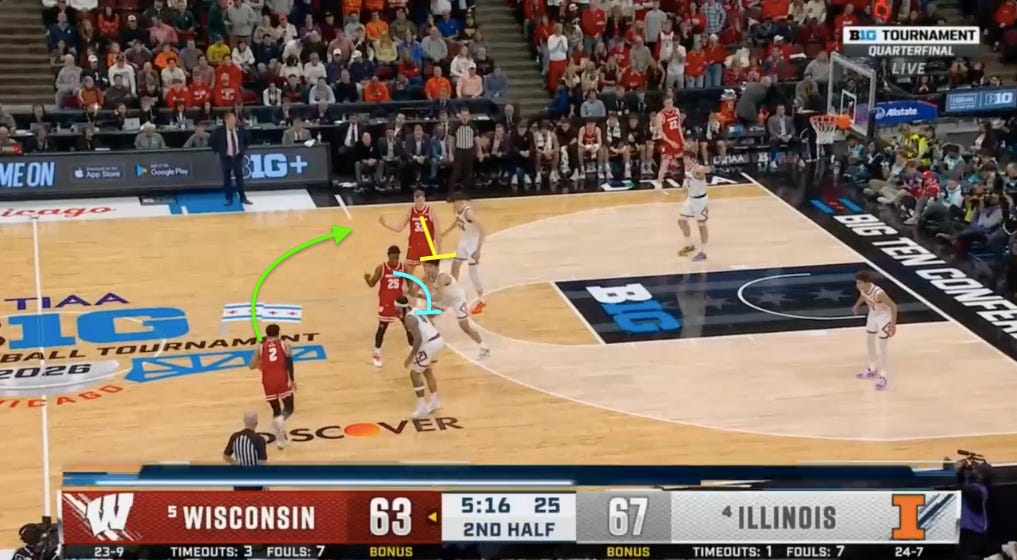
As soon as Boyd clears the first screen, Blackwell rolls toward the elbow and then turns back up the floor. Boyd continues left off a second ball screen from Bieliauskas, who then sprints toward Blackwell to set a down screen.
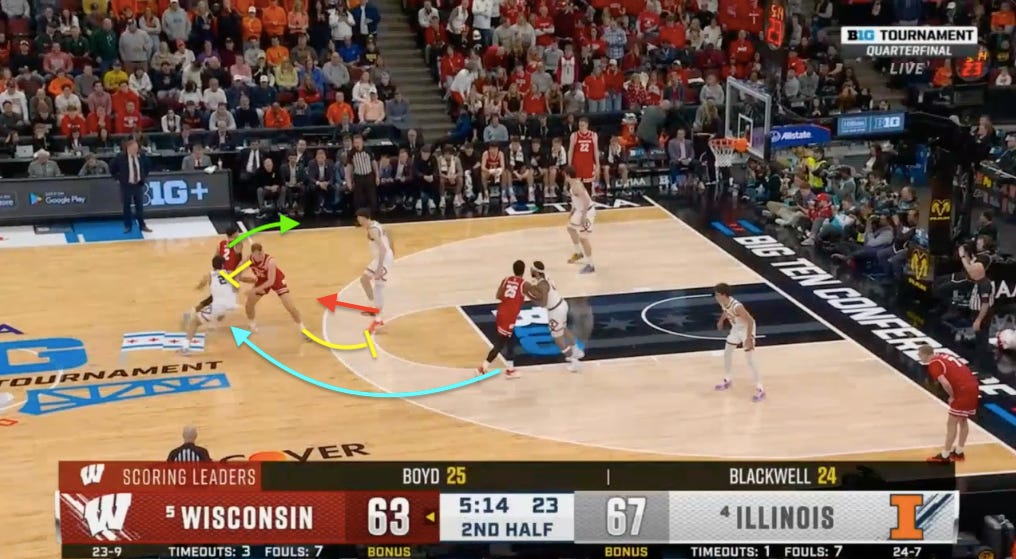
With Boyd pulling defenders toward the left wing, Blackwell races back up the floor into the vacated space. Illinois is in its customary drop coverage, so when Boyd swings the ball back to Blackwell coming off the down screen, there's room to curl into. Wagler tries to chase from behind, but Blackwell creates separation off the pindown and lets it fly from 3.
In recent years, Wisconsin coach Greg Gard has shifted the program’s offensive approach, moving away from Bo Ryan’s methodical “Swing“ offense toward a 5-out, continuity ball-screen system. The Badgers space the floor and play with good pace in the half court, flowing side to side with ball reversals through the slots and initiating empty-side pick-and-rolls.
While this transition has reduced some of Wisconsin’s traditional off-ball motion sets, it has allowed Blackwell to flourish as a shooter off kick-outs, a downhill attacker along the edges of the defense and a threat in high handoff actions when the continuity flows into 5-out “Zoom” action.
This new arrangement — an alteration of the alchemy — improved the offensive balance in Madison. Over the past two seasons, the Badgers have played faster and taken more 3-pointers than ever before. In the 2025–26 season, Wisconsin ranked No. 6 nationally, with 52.1 percent of its field goals coming from beyond the arc. The Badgers also averaged 17.2 seconds per offensive possession. Compare that to just two years earlier — Blackwell’s freshman season — when Wisconsin posted a 3-point attempt rate of 35.5% (No. 225) and averaged 19.0 seconds per possession, according to KenPom.
More broadly, Blackwell should fit cleanly into Duke’s 5-out spacing and overall offensive approach: spacing the arc, moving the ball, generating high volumes of 3s and attacking off the dribble with purpose.
During his junior season, Blackwell’s usage rate held steady at 25.6 percent as he developed into one of the top shooters in the Big Ten, posting career highs in offensive box plus-minus, true shooting percentage (59.3 TS%), free throw percentage (85.9 FT%) and total 3-pointers made (96).
Let’s take a look at what he brings to the table, how he fits with Duke’s current roster and where he may excel most within the team’s scheme.
Moving In Durham
There’s more than enough data and film to support the idea that Blackwell is a prolific deep-ball shooter, but there’s still another level for him to reach, and Duke’s offense has the potential to help him get there. For now, I’d label him a tier below the “gravity-bending” distinction that movement shooters like McCain, Knueppel and Evans earned in Durham. However, he has the opportunity to take another step in terms of the volume-efficiency balance and how defenses respond to his movement, particularly when playing off Ngongba.
With Ngongba back, Duke has one of the best frontcourt passing hubs in the country. Whether facing up in 5-out sets or working against double teams in the post, Ngongba can find cutters and shooters with pinpoint accuracy. This Blue Devils team will be guard-heavy, featuring multiple creators who can organize the offense and attack out of ball screens, but Ngongba will take on a central creation role as a high-post passing tower.
Ngongba is adept at finding cutters in Duke’s 5-out split action, locating teammates slipping behind the defense for easy baskets. According to CBB Analytics, he averaged 1.2 assists per 40 minutes on rim finishes, which ranked in the 97th percentile for centers.
That should benefit everyone on the roster, especially guard/wing cutters like Dame Sarr and Blackwell, who showed good pop as downhill cutters last season.
On this possession against UNC, Duke runs what I refer to as its "L" series into 5-out split action: Ngongba in the middle of the floor, with Sarr and Evans running toward one another before splitting in different directions. The gravity of Evans forces UNC to switch the action, and Sarr takes advantage, slipping behind Jarin Stevenson and getting to the rim for an uncontested dunk off a well-timed feed from Ngongba.
Sarr and Blackwell will likely work well together in these types of combos together next season, with Blackwell screening and slipping all over the floor.
Ngongba also brings a natural feel as a high-post handoff hub. Duke’s guards often deliver him the ball, fake a basket cut, then sprint back toward him, curling around a handoff from Ngongba and flowing straight into their shots or downhill drives. Over their two seasons together at Duke, Ngongba and Evans thrived in these two-man actions.
Now, it will be up to Ngongba and Blackwell to build that same kind of chemistry over the offseason.
Beyond that, it’s a safe bet Duke will use Blackwell in a variety of screen-the-screener actions: he sets a back screen for a teammate, then cuts off a pindown or flare in the opposite direction.
Wisconsin regularly ran this screen-the-screener (STS) action for Blackwell on baseline-out-of-bounds plays. The Badgers would start in a “Box” set, have Blackwell set a slice screen for the big at the opposite elbow, then send him off a down screen to the strong-side corner.
One of Duke's go-to baseline-out-of-bounds plays is also an STS call for its top shooter: Knueppel, McCain, Proctor, Whitehead and Evans have all run it. Instead of a Box formation, Duke uses a "Triangle" setup: three players spaced along the baseline, with the 5 in the strong-side corner and the featured shooter in the middle of the lane, while the 4 is spaced at the top of the key. The shooter turns to set a back screen for the 4 (Boozer on this possession against Kansas), then cuts to the corner off a screen from the 5.
Looks familiar, right? You can expect to see Blackwell hunting shots out of this action next season.
These movement sets will come on a variety of half-court sets, too, not just baseline-under plays. As I’ve written over the past three seasons, few programs in the country get more out of flare screens in their half-court offense. Duke excels at clearing one side of the floor, having a big set a flare screen for a shooter, then skipping a pass over the top for an open 3.
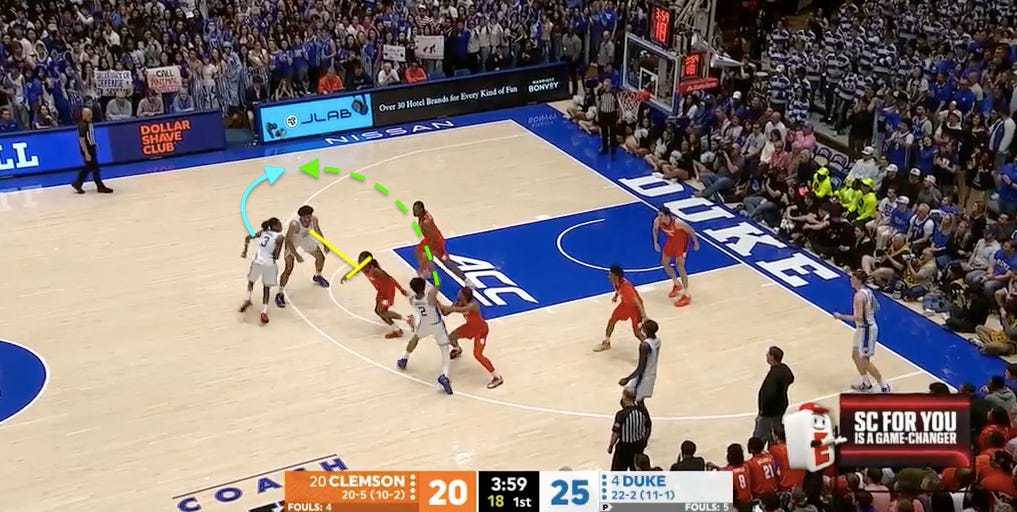
Here's what I refer to as Duke's "Spain Swipe" action: stack pick-and-roll action against Clemson, but instead of having the 5 (Boozer) roll downhill to the rim, he stops to set a flare screen for Evans, who slips setting a back screen on the defensive 5 and cuts to the vacated weak-side wing — off the flare.
This was a new play type for Duke this past season, and Evans cooked out of it. Assuming it remains in the playbook for 2026–27, Blackwell should be in line to benefit from these clean catch-and-shoot looks.
Pull-up Shooting
Blackwell already puts fear into opposing coaches with his off-ball movement and catch-and-shoot efficiency, but he’s also a highly versatile scorer who can heat up from multiple levels and create off the bounce, too. During his junior season, he averaged 13.1 unassisted points per 40 minutes.
He didn’t take that many midrange shots this past season, but he still shot 40.3 percent on paint attempts away from the rim (53rd percentile) and 36 percent on 2-point attempts outside the paint (54th percentile). These shots aren’t the engine of his offensive upside, but they help establish a foundation and become especially valuable in late-clock, high-leverage situations.
In Wisconsin's road upset win at Michigan, there's a telling example: with the game tied at 79 and about five minutes remaining, Blackwell dribbles left off an empty-side ball screen, drawing a switch onto Morez Johnson, one of the most versatile frontcourt defenders in the country. He attacks baseline, creates separation with a sharp step-back — subtly pushing off to gain space — and rises for the jumper. He has Boyd available on a paint cut but stays locked in on the shot and drills it.
One of Blackwell's go-to spots is the left wing. When Wisconsin runs a ball screen for him there, he can attack middle or reject it and drive baseline. In isolation, he often looks to get downhill along the baseline; if that's cut off, he can pivot to a step-back — like he hit against Johnson — or spin into a fadeaway. In these situations, he does an excellent job operating out of the triple-threat position.
Blackwell led Wisconsin with 25 unassisted 3-pointers this season — about 26 percent of his total makes from deep. He can operate in isolation or punish different coverages out of the pick-and-roll. If his defender goes under the screen, Blackwell has the proverbial green light.
Duke’s offense in 2025-26 missed a twitchy, off-the-bounce shooter with range — someone that could punish drop coverage from 25 feet out. As great as Evans was, he largely needed to play off the catch. Blackwell doesn’t have the same length (8-foot-2 standing reach to 8-foot-8.5 standing reach for Evans) or high-end movement as Evans, but he offers versatility in this area.
Alternatively, if the defense switches a bigger defender onto him, Blackwell can get into his bag, find a rhythm and rise into pull-up 3 — as he does here against Mara, who starts in drop coverage before eventually switching onto him.
Wisconsin opens this possession at Purdue with a "Floppy" action before flowing into an empty-corner pick-and-pop, with Blackwell handling. He drives left and waits for Jacobsen to recover to Bieliauskas on the pop, creating a clean 1-on-1 situation in space with Jack Benter trying to stay in front. Blackwell sells the baseline drive, then counters Benter's momentum with a sharp pull-back crossover, flowing right into his gather for a step-back 3-ball.
Blackwell isn’t an elite space creator with a live dribble, but he can certainly get the job done when needed. His handle is functional and his shot is compact, allowing him to create advantages and capitalize on them.
Paint Touches and Passes
During his junior season, 74.6 percent of Blackwell’s field goal attempts came either at the rim or from 3-point range. That’s a strong concentration of shots coming from the “money spots” on the floor, although rim attempts accounted for just 21 percent of those shots (42nd percentile among guards), which he converted at 58.8 percent, per CBB Analytics.
At Duke, you can expect that distribution to either hold steady or tilt even further toward the extremes, with closer to 80 percent of his attempts coming from beyond the arc and at the rim. That shift would only enhance his already efficient offensive profile.
Blackwell recorded just three dunks across his three years in Madison, all of which came during his sophomore season, and he has a career block rate of just 0.3 percent. He’s not an above-the-rim finisher, nor is he the type of guard who lives in isolation constantly trying to beat defenders off the dribble. But there’s a suddenness to his driving game, and he can win with his frame, a decisive handle and a quick first step. That’s how he unlocks a subtle but effective dribble-drive package.
As a junior, Blackwell drew 5.0 fouls per 40 minutes, including 2.2 shooting fouls per 40, ranking in the 87th percentile among Division I guards.
Defended on this late-game possession by Michigan’s Yaxel Lendeborg, a strong and impactful defender, Blackwell opts to drive downhill before Bieliauskas can come over and set a screen for him. Blackwell plants his right foot and explodes past Lendeborg with an impressive first step. Sensing that Lendeborg will sell out to challenge the shot from behind — and with the athletic Roddy Gayle rotating over as help — Blackwell slams on the brakes, shot fakes, gets both defenders in the air and finishes in the restricted area.
This is a really nice mix of speeds from Blackwell, who goes from 0 to 60 and back to 0 in a matter of seconds.
Blackwell also amplifies his off-ball scoring package by turning these movement opportunities into downhill drives. Here’s that same baseline-out-of-bounds Box STS action for Wisconsin. Instead of curling to the corner for a 3, Blackwell fades off the screen, catches the ball higher on the floor and is immediately ready to pressure the paint. He turns the corner and gets all the way to the rim for an impressive finish.
He can win as a driver with more than just ball fakes and straight-line speed. Blackwell also leverages his frame and strength to initiate contact and play through bumps.
At Indiana, Wisconsin runs more Floppy action with Blackwell on the left side of the floor. He comes flat off a wide down screen, and as soon as he receives the pass from Andrew Rohde, he’s immediately driving baseline in the opposite direction. Conor Enright, who defends him on this possession, is smaller and a notorious flopper. Enright tries to sell the contact, but Blackwell powers through, Euro-steps past the falling defender and finishes on the other side of the rim with a smooth reverse layup.
He doesn't necessarily need a size mismatch to unlock his power game as a driver, either. Blackwell comes off a handoff in early offense against Michigan with Johnson fighting to stay in front of him. Blackwell feels the pressure and knows he needs to create separation from Johnson, an elite rim protector. Instead of rushing the finish off the glass, he uses his upper body to bump Johnson and crack open a little space, finishing a layup just before Mara can rotate over to contest.
Blackwell has a career assist rate of 12.2 percent and a turnover rate of 13.1 percent. So far, he's been much more of a station-to-station passer — as opposed to someone who takes over a came with his court-mapping and multi-level passing.
While at Wisconsin, Blackwell played alongside high-usage guards like Chucky Hepburn and John Tonje, and he knows how to function next to talented, ball-dominant teammates — experience that should serve him well amid a crowded backcourt in Durham. Blackwell doesn't have elite passing traits, but he does add another player to the lineup who can create shots for both himself and others. He can operate out of the pick-and-roll as a secondary creator, finding teammates for open kick-out 3 off his scoring gravity and connecting with rim-runners on pocket passes.